Search Results

Like to listen to what goes on behind the scenes in film making or acting straight from an actor? Click here.

A Reunion Dinner with a secret to hide. Click here.

Have you taken all the modern comforts for granted? Behind every modern device there is the technology and with them comes the management and risks. Interested to find out what goes on below the hood? Click here.

Wednesday, February 11, 2009

The Futurists 2 - Transhumanism


29th January 2009 - I have been hesistant as to whether I should blog about this meeting on "Transhumanism", as I couldn't really follow the discussion, particularly about the many books that were introduced. Besides, the location (for this particular session only) wasn also too noisy and distracting.
.
First the definition from Wikipedia:
Transhumanism is an international intellectual and cultural movement supporting the use of science and technology to improve human mental andphysical characteristics and capacities. The movement regards aspects of the human condition, such as disability, suffering, disease, aging, and involuntary death as unnecessary and undesirable. Transhumanists look to biotechnologies and other emerging technologies for these purposes. 
.
The Books:
.
The Scientific Conquest of Death, published by the Immortality Institute:


From Amazon.com : Nineteen scientists, doctors and philosophers share their perspective on what is arguably the most significant scientific development that humanity has ever faced - the eradication of aging and mortality. This anthology is both a gentle introduction to the multitude of cutting-edge scientific developments, and a thoughtful, multidisciplinary discussion of the ethics, politics and philosophy behind the scientific conquest of aging... more
.
.
Our Posthuman Future: Consequences of the Biotechnology Future:

Author Francis Fukuyama argues that as a result of biomedical advances, we are facing the possibility of a future in which our humanity itself will be altered beyond recognition. Fukuyama sketches a brief history of man's changing understanding of human nature: from Plato and Aristotle to modernity's utopians and dictators who sought to remake mankind for ideological ends. Fukuyama argues that the ability to manipulate the DNA of all of one person's descendants will have profound, and potentially terrible, consequences for our political order, even if undertaken with the best of intentions.
.
.
The Artilect War: Cosmists vs Terrans: A Bitter Controversy Concerning Whether Humanity Should Build Godlike Massively Intelligent Machines

This book’s main idea is that this century’s global politics will be dominated by the "species dominance" issue. 21st century technologies will enable the building of artilects (artificial intellects, artificial intelligences, massively intelligent machines) with 1040 components, using reversible, heatless, 3D, molecular scale, self assembling, one bit per atom, nano-teched, quantum computers, which may dwarf human intelligence levels by a factor of trillions of trillions and more.
.
The question that will dominate global politics this century will be whether humanity should or should not build these artilects. Those in favor of building them are called "Cosmists" in this book, due to their "cosmic" perspective. Those opposed to building them are called "Terrans," as in "terra," the Earth, which is their perspective. The Cosmists will want to build artilects, amongst other reasons, because to them it will be a religion, a scientist's religion that is compatible with modern scientific knowledge... more
.
.
Designer Evolution: A Transhumanist Manifesto
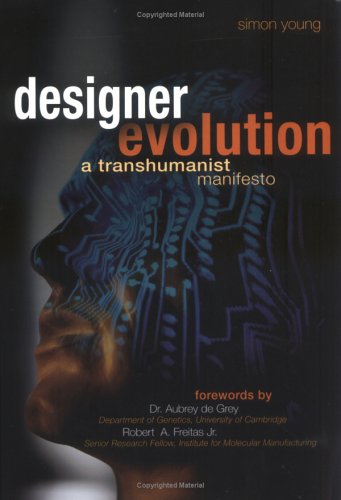

Designing Evolution presents an overview and vigorous defense of the transhumanist philosophy, which the author defines as "the belief in overcoming human limitations through reason,science and technology." 
.
Simon Young, a pianist and son of the cybernetician J.F. Young, calls for a renewed belief in human progress through scientific rationality, and predicts the emergence of a twenty-first-century transcendence through science. 
.
.
Evolution's Arrow

Evolution's Arrow argues that evolution is directional and progressive, and that this has major consequences for humanity. Without resort to teleology, the book demonstrates that evolution moves in the direction of producing cooperative organisations of greater scale and evolvability - evolution has organised molecular processes into cells, cells into organisms, and organisms into societies. The book founds this position on a new theory of the evolution of cooperation. It shows that self-interest at the level of the genes does not prevent cooperation from increasing as evolution unfolds. Evolution progresses by discovering ways to build cooperative organisations out of self-interested individuals. more
.
.

Campbell discusses the importance of accepting death as rebirth as in myth of the buffalo and the story of Christ, the rite of passage in primitive societies, the role of mystical Shamans, and the decline of ritual in today's society. more
.
Patterns in Prehistory

.
Patterns in Prehistory , Fifth Edition, is a comprehensive and engaging survey of humanity's past three million years. It brings together theories and archaeological examples to pose questions about who we are and the means by which humanity evolved into what it is today.
.
.
All the above-mentioned books were rapidly discussed on how the authors opine about the evolution to transhumanism and whether we will one day reach singularity.
.
Going around the table, we asked each of us to voice what they would like to get out of transhumanism, or even the disagreement of the whole idea. Here are the following points:
  • To have higher brain processing power and memory
  • To grow old without being weak and wrinkly old.
  • To be able to download skills to ourselves, without having to learn consciously.
  • To be able to have better health.
  • To enhance empathy to other beings
  • To improve cognitve ability
  • To improve my thoughts
[End of meeting]
.

Tuesday, February 10, 2009

In Sickness and In Health 10 - Heart Attack

Just got news minutes ago that my associate got a heart attack. He was fine when we met two days ago. I guess he has been under a lot of stress. Now he joins two others I know in the occupation who got such attacks. This reminds me to take a long holiday soon.
.
ps. Just visited my friend in the intensive care unit of the hospital. He is doing fine. Apparently he had a medical checkup recently and blood pressure and colesterol levels were healthy. So, it must have been the mental stress. From now, I need to remind myself to watch my thoughts, as it is thoughts lead to anything else.

Saturday, February 07, 2009

Environment 8 - Mozzies

My bedroom is swarmed by mosquitoes. A few weeks of continuous dry weather have bred many of these blood-sucking creatures.
.
I tried the chemical-aerosol spray. It didn't get rid of them. Perhaps they have developed an immunity to chemicals. Then, I tried electrically activated chemical repellent - that didn't work either.
.
I am now trying the organic repellent - heated on the dish to create an aroma hated by the pesky creatures. It seems to work the first night. I guess insects can develop an immunity to chemicals quickly, but not to their natural repellents.
.
However, last night, it didn't work quite that well, as after initially ridding them off, more flew in, in the middle of the night, keeping me awake. Haiz! I am going to report it to the estate manager tomorrow morning. I guess there must be a breeding ground somewhere.
.

Visa

I just came back from the embassy of a Gulf country in the Middle East, where I was asked to show the contract I have with my client before they could grant me the visa. 
.
It then dawn on me that I have been working with my client for a few years now without a contract. Each time I sent my invoice I got paid, all based on trust. I am very grateful that I have this very trusting relationship, sadly not very common these days.
.

Thursday, February 05, 2009

The Futurist 1a - Art


Got this from an email today:

A Violinist in the Metro. 

A man sat at a metro station in Washington DC and began to play a violin;
It was a cold January morning.
He played six Bach pieces for about 45 minutes.
During that time,
Since, it was rush hour,
It was calculated that thousands of people went through the station,
Most of them on their way to work.

Three minutes went by and a middle aged man noticed there was a musician playing.
He slowed his pace and stopped for a few seconds and then hurried up to meet his schedule..
 A minute later,
The violinist received his first dollar tip:
A woman threw the money in the till and without stopping continued to walk.

A few minutes later,
Someone leaned against the wall to listen to him,
But, the man looked at his watch and started to walk again.
Clearly he was late for work.

The one who paid the most attention was a 03 year old boy.
His mother tagged him along,
Hurried but, the kid stopped to look at the violinist.
Finally, the mother pushed hard and the child continued to walk turning his head all the time.
This action was repeated by several other children.
All the parents, without exception, forced them to move on.

In the 45 minutes the musician played,
Only 07 people stopped and stayed for a while.
About 27 gave him money but, continued to walk their normal pace.
He collected $32..
When he finished playing and silence took over,
No one noticed it.
No one applauded,
Nor was there any recognition.

No one knew this but the violinist was Joshua Bell,
One of the best musicians in the world.
He played some of the most intricate pieces ever written with a violin worth 3.5 million dollars.

Two days before his playing in the subway,
Joshua Bell sold out at a theatre in Boston and the seats average $100.

This is a real story.
Joshua Bell playing incognito in the metro station which was organised by the Washington Post as part of a social experiment about
Perception, Taste and Priorities of people.
The outlines were:
In a commonplace environment at an inappropriate hour:
Do we perceive beauty?
Do we stop to appreciate it?
Do we recognise talent in an unexpected context?


One of the possible conclusions from this experience could be:

If we do not have a moment to stop and listen to
One of the best musicians in the world playing
the best music ever written,
How many other things are we missing?


Wednesday, February 04, 2009

The Futurists 3 - The Economy

29th January 2009 - This is the fourth day of Lunar New Year, so only five people turn up today. While waiting for the rest to turn up, I asked Stefan, since he is a coin collector, what he thinks about the Amero coin.
.
From Wikipedia:
The idea for a North American currency union was first proposed in 1999 by Canadian economist Herbert G. Grubel. A senior fellow of the conservative Fraser Institute think-tank, he published a book titled The Case for the Amero in September 1999, the year that the euro became a virtual currency. Another Canadian think-tank, the C.D. Howe Institute, advocates the creation of a shared currency between Canada and the United States.
.
After the report came out, center-left nationalist groups in Canada expressed their opposition to any currency union because they view it as an attempt by American businesses to gain access to Canada's extensive natural resources while dismantling the nation's social services. more
.
Stefan said that there is also the parallel currency in the US called "Liberty coins".
.
From Wikipedia:
The Liberty Dollar is a private currency embodied in minted metal pieces (referred to as rounds) and gold and silver certificates (ALD), and electronic currency (eLD).
.
"But is it legal?" I asked.
"Well, some people consider the US dollar less legal, in that it is not based on gold or any other precious metal", Stefan replied.
.
Also from Wikipedia:
The Liberty Dollar warehouses were raided and the contents confiscated by the FBI and Secret Service on 15 November 2007. The FBI states that this confiscation is intended to prevent people mistaking Liberty Dollars for legal tender; the Liberty Dollar organization is accused of illegally presenting the currency as a legal alternative to the United States dollar. To date, no one has been accused of any crime. The gold, silver, and copper seized has been accused of being proceeds of crime, but no criminal charge is pending.
 
Since departing from the gold standards, governments can just print money. This can cause inflation and chaos to the economy. The Argentinian economy in the year 1999-2002 went through a tailspin as many people changed pesos for US dollars, as the former quickly lost its value.
.
One way out is to go into barter trade. There are already several established barter exchanges around, like barterxchange.com . During the 2001-2003 recession in France, there were Parisians who gave up their dwellings in Paris and left for the rural villages to form barter communes when they lost their jobs. There, they exchanges goods and services, or accredited barter points, without the use of money.
. 
Will there be taxes for barter?

From allbusiness.com : 
Like other transactions, however, barter sales are taxable, and your company must report them to the IRS. This is also true of credits you receive or spend through a barter exchange; regardless ofhow you use barter credits, they're taxable as if they were cash.

The U.S. Government considers barter exchanges to be legal third-party record keepers, similar to banks, brokerages, and other firms that deal with taxpayer records.  
.
However, I think enforcement of this law will be difficult and laborious to upkeep, particularly in France and other Southern European countries.
.
There is also an exchange in the Internet that trades virtual currencies from role playing online games, and at one time, this exchange trades more money than there is in the real world. Readmore.
.
How about an economy where everyone works only for passion and not for money, because whatever we need is already paid for? Is this Utopia or Oblivion? In Buckminster Fuller's ideal world, he envisaged such an economy in his Chapter on "World Game" in his book "Critical Path". Read more. In it, he envisaged wealth to be distributed by a global electricity grid.
.
This is not so much a dream now if you consider some of the voluntary work that is already going on in our economy. And that is not to say it is only the free labour we find in charities, like volunteer paramedics and volunteer counsellors, but also some tasks that we have unwittingly volunteered. More so done for multi-nationals reaping huge profits, like withdrawing cash from the ATM machines. This was done previously by human cashiers. Yet we have grown accustomed to doing it ourselves. Other common free labour are: the Open Source programmers, bloggers (like this one) and podcasters. 
.
Author and futurist Alvin Toffler calls this mix of producer and consumer in the same person, Prosumer. He describes it in further detail in his book "Revolutionary Wealth". Read more

At this point, it is about 7.45pm and everyone has turned up. Stefan then introduced the book, "The Wealth of Nations". 
.
Adam Smith's masterpiece, first published in 1776, is the foundation of modern economic thought and remains the single most important account of the rise of, and the principles behind, modern capitalism. Written in clear and incisive prose, The Wealth of Nations articulates the concepts indispensable to an understanding of contemporary society;
.
From Wikipedia:
An Inquiry into the Nature and Causes of the Wealth of Nations is the magnum opus of the Scottish economist Adam Smith. It is a clearly written account of economics at the dawn of the Industrial Revolution, as well as a rhetorical piece written for the generally educated individual of the 18th century - advocating a free market economy as more productive and more beneficial to society.
.
Adam Smith's "the invisible hand" refers to the ability of the market (of demand and supply) to self-correct from seemingly disastrous situations with no intervention on the part of government or other organizations. This is what the Austrian School of Economics is based on. It advocates a laissez faire approach to the economy.
.
Keynesian economics based on the ideas of twentieth-century British economist John Maynard Keynes, however, says that the state should stimulate economic growth and improve stability in the private sector — through, for example, adjusting interest rates and taxation and funding public projects.
.
Stefan brought up the concept of one using one's reputation to make money on the Web. Here money may be of a variety of currency other than those commonly found in the physical world. It could come in the form of virtual money or points accredited to one's persona and knowledge ratings.
.
Actually, capitalising on one's reputation to make money is already happening in the physical world, for instance, where the trades of famous stock traders with a midas touch are religiously followed by others. The difference in the Internet is that the speed and intensity of the use of such reputation can be rapidly scaled up.
.
In the Internet, there is such rating sites such as diggs. Essentially, it is a voting system, where if you like something, just give it your vote.
.
Digg is a place for people to discover and share content from anywhere on the web. From the biggest online destinations to the most obscure blog, Digg surfaces the best stuff as voted on by our users. You won’t find editors at Digg — we’re here to provide a place where people can collectively determine the value of content and we’re changing the way people consume information online... more
.
Developing further from such online voting system for subjects, one can adopt a different persona in different subject matters, skills and expertise. Voting is also effective on the Internet as it can be done anoymously.
.
However, does voting lead us to compromising to the whims and fancies of the lowest common denominator?
.
This is less problematic now as more people are educated, though, it does not remove the problem altogether, as no matter how educated the population becomes, there will always be issues that the common people find it hard to grapple with.
.
However, I find that in Cyberspace, votes, perception and accepted norms come into a stable state after some time, say a few months.
.
The Google search engine has certain criteria to rank web pages. It is not published how its search engine works, but it is suspected that it gives some priority to originality of content. It also has a facility for users to add a website to the search, if it did not already appear in his search. Commentary of the websites that appear in the search will also be a feature soon.
.
Next, Stefan brought out an observation he has made in the price of silver coins bidded on eBay. In the last few months, he has witnessed people bidding from 10% above the spot price of silver to now 90% of the spot price. This is when production of those coins have doubled and the price of silver has gone down from $20 to $9. (Commodity prices has collapsed recently as we see traders needing to liquidate to gather more cash, in the absence of credit lines from the banks.) This means that the price of the coins didn't go up, but maintained about the same price. More importantly, it did not go down with the price of raw silver. This could well mean that in times of crisis (or a perceived one), people feels more secure owning physical assets like silver coins.
.

.
[end of meeting]


Monday, February 02, 2009

A Little Indian Philosophy 4 - Holy Cow

Today, I have a cattle farmer on one side and two Hindu Indian vegetarians on the other. This sounds like a meeting of opposing forces, but far from confrontation, the latter is even helping the former to set up the farm.
.
"Isn't this difficult?" I asked.
.
My Indian friend smiled and replied calmly that he separates business from personal beliefs. Naturally, religion is a personal commitment and cannot be imposed on anyone else. 
.
"In the end, it is all about atma..." he continued.
.
In Hinduism, 'atma' is one's true self beyond identification with the phenomenal reality of worldly existence. So even plants, for instance, have 'atma', only that they don't have the nervous system to experience the kind of pain as we know it.
.
What amazed me was that the vegetarians did not look down on the cattle farmer, something I find increasingly common and disturbing these days. While vegetarians believe in vegetarianism, they should allow others free to walk their own spiritual journey - only then would their journey be meaningful beyond the compulsion and rigidity of dogma.
.
Lest you may be tempted to think cattle farming is much about killing cows, there is a spiritual lining to this one. In the end, I think all businesses can be spiritualised - even cattle farms. Read here for more.
.